Social Media and Political Campaigns: 11 Key Trends in 2026
The landscape of political campaigning has undergone a dramatic transformation in recent years, largely driven by the rise of social media. What was once dominated by television ads, radio broadcasts, and physical rallies has now shifted into a fast-paced digital environment where messages can spread globally in seconds. Platforms have become powerful tools for politicians, enabling them to connect directly with voters, shape narratives, and influence public opinion in ways that were previously unimaginable. The intersection of social media and political campaigns is now the central arena for modern elections.
We are navigating an era where digital strategy isn’t just an addition to a campaign; it is the campaign. If you are not optimizing for these platforms, you are essentially invisible. For political strategists and voters alike, understanding the role of social media and political campaigns in 2026 is crucial to deciphering the democratic process. This guide provides an authoritative breakdown of the digital forces currently redefining political communication and mobilization.
Key Takeaways:
The primary impact of social media and political campaigns in 2026 is the total bypass of traditional media gatekeepers, allowing direct, real-time candidate-to-voter interaction.
Data-driven microtargeting on these platforms has become the primary method for delivering personalized campaign messages to specific demographics.
The rise of influencers as political surrogates on social media has created new, powerful channels for grassroots mobilization and digital endorsements.
Misinformation and algorithmic bias remain critical challenges that campaigns must actively manage to protect their narrative and voter trust.
Direct Communication Between Politicians and Voters
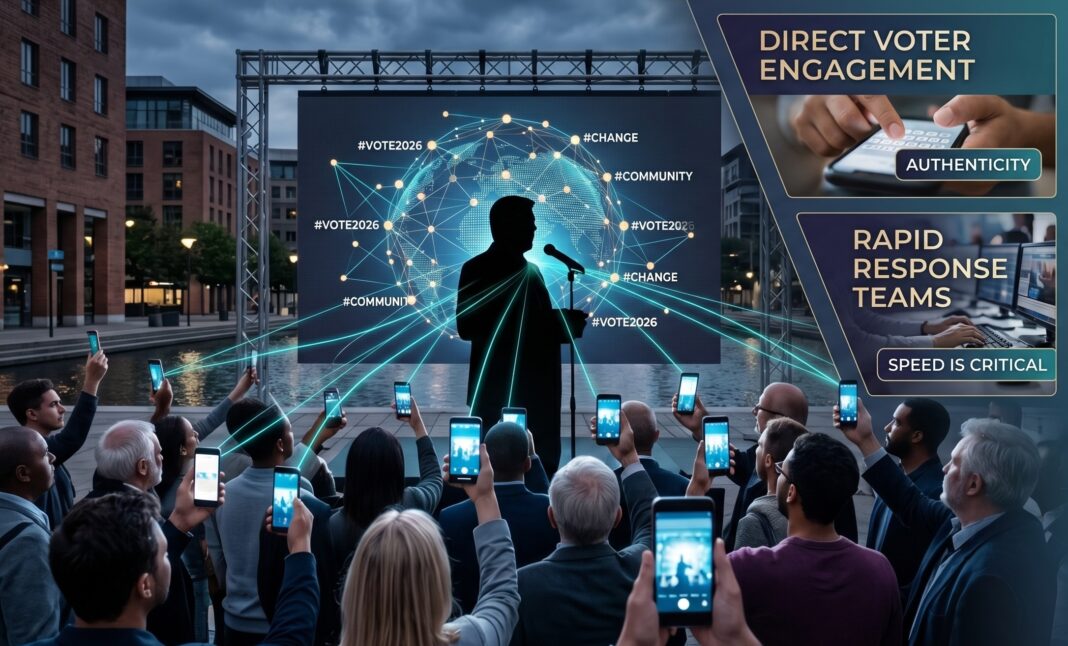
One of the most significant changes brought by social media is the ability for political candidates to communicate directly with the public. Traditional media once acted as a gatekeeper, filtering and interpreting political messages before they reached audiences. Today, platforms allow politicians to bypass these intermediaries.
This direct line of communication creates a sense of accessibility and authenticity. Voters can follow candidates, read their thoughts in real time, and even engage with them through comments and messages. This helps humanize political figures, making them appear more relatable. Within the context of social media and political campaigns, this authenticity is a highly valued asset, but one that is vulnerable to hasty statements that can quickly go viral.
The Power of Viral Content and Rapid Response
Social media thrives on shareable content, and political campaigns have adapted by creating messages designed to go viral. Short videos, memes, infographics, and catchy slogans are now essential components of campaign strategies.
Campaign teams must constantly monitor trends and adapt their messaging to stay relevant. Real-time engagement is no longer optional; it is a requirement. This has led to the development of rapid response teams dedicated to address issues as they arise, countering misinformation, or capitalizing on a trending topic. Within the ecosystem of social media and political campaigns, speed is critical.
Data-Driven Campaign Strategies and Microtargeting
Social media platforms provide access to vast amounts of user data, which has revolutionized how political campaigns are executed. This data allows for microtargeting, where personalized content is delivered to different groups of voters based on their preferences and behavior. Data-driven strategies ensure that resources are used effectively, a cornerstone of maximizing the influence of social media and political campaigns.
Influencers and the New Digital Endorsements
A key trend in modern political campaigns is the use of influencers. Social media personalities with large followings can have a significant impact on public opinion. Political campaigns are increasingly collaborating with these influencers to reach younger audiences and expand their reach. These endorsements can be highly effective because they come from individuals who are perceived as trustworthy and relatable by their followers. This is a crucial, evolving component of how social media and political campaigns utilize social proof in 2026.
WHAT MOST ARTICLES GET WRONG
Most analysts focus on which candidate has the most followers. What they get wrong is ignoring “Semantic Satiation and Fatigue.” In 2026, high follower counts do not automatically translate to votes.
The most successful strategies within social media and political campaigns aren’t about broadcasting to everyone; they are about Deep Engagement with Niche Communities. A smaller group of highly activated, real followers who consistently share content within their personal networks is infinitely more valuable than millions of passive, low-engagement “fans.” The true measure of power in 2026 is the Velocity of Conversion—how fast a digital engagement turns into a volunteer sign-up or a donation, not the volume of digital noise.
Challenges of Misinformation, Bias, and Polarization
While social media and political campaigns offer many advantages, they also present serious challenges, particularly misinformation. Inaccurate or misleading content can spread quickly, influencing public perception before it can be countered.
This makes it essential for campaigns to prioritize transparency and fact-checking. Furthermore, algorithmic bias—where platforms prioritize high-arousal, often negative, content—can contribute to political polarization. Navigating this environment, balancing free expression with the need to prevent harm, is a constant struggle for both campaigns and platforms themselves.
Source: https://www.pewresearch.org/internet/2021/04/07/social-media-use-in-2021/
Why This Matters
Recognizing these shifts is not an academic exercise; it is an economic and civic necessity. For the voter, it means that media literacy is now a survival skill. For the candidate, it means that your reputation can be built or destroyed in a matter of seconds. In 2026, the intersection of social media and political campaigns is the definitive landscape where the future of governance and policy is being decided. If you ignore this reality, you are ceding control of your political narrative to others.
Expert Prediction: The Rise of “Sovereign Algorithmic Verification”
I predict that by 2028, the defining trend will be the creation of “Sovereign Algorithmic Verification” standards. To combat deepfakes and mass automated disinformation, political campaigns will move toward cryptographically verified messaging. Voters will learn to only trust content that carries a digital “watermark of origin,” effectively creating a two-tier information system and fundamentally altering how social media and political campaigns distribute information.
FAQ
What is the role of social media in political campaigns?
It is the primary channel for direct candidate-to-voter communication, microtargeting, rapid response, and grassroots mobilization. It has largely replaced traditional media as the central town square for political discourse.
How do politicians use microtargeting on social media?
Politicians use microtargeting to deliver specific messages to very narrow demographics based on user data. This ensures that an economic message reaches a voter interested in jobs, while an environmental message reaches a voter interested in climate change.
What is rapid response in digital campaigns?
Rapid response is the tactic of immediately reacting to news, attacks, or trends on social media. It requires dedicated teams to monitor and address issues within minutes to shape the narrative.
Are influencers effective in political campaigning?
Yes, influencers are highly effective because they often have a closer, more relatable relationship with their followers than traditional celebrities or politicians. Their “digital endorsements” are a critical tool in social media and political campaigns.
Why should I care about semantic satiation?
Semantic satiation (message fatigue) is why generic “vote for me” posts no longer work. Understanding this helps voters identify authentic messaging and helps campaigns realize that high follower counts do not equal high engagement.
In conclusion, social media and political campaigns are now permanently intertwined, transforming how candidates communicate, engage, and compete. It has created new opportunities for connection and participation while introducing serious challenges. In 2026 and beyond, the influence will only grow. Campaigns that can effectively navigate this digital landscape, balance innovation with responsibility, and build genuine connections with voters will be best positioned for success in the 2026 landscape and beyond.