12 Trends Defining Global Politics in 2026 and Beyond
Global politics in 2026 is shaped by rapid change, shifting alliances, and the growing influence of technology, economics, and public sentiment. Nations are no longer operating in isolation; instead, they are deeply interconnected through trade, communication, and shared global challenges. As a result, political decisions in one region can have ripple effects across the world. Understanding the key trends defining global politics in 2026 is essential for anyone looking to grasp the direction in which the world is heading.
We are currently navigating a structural redesign of international relations. The frameworks established in the 20th century are giving way to new realities defined by dynamic power, not static treaties. If you fail to adapt to these shifts in global politics in 2026, you aren’t just misreading the news; you are ignoring the blueprint for the future of governance and security.
Key Takeaways:
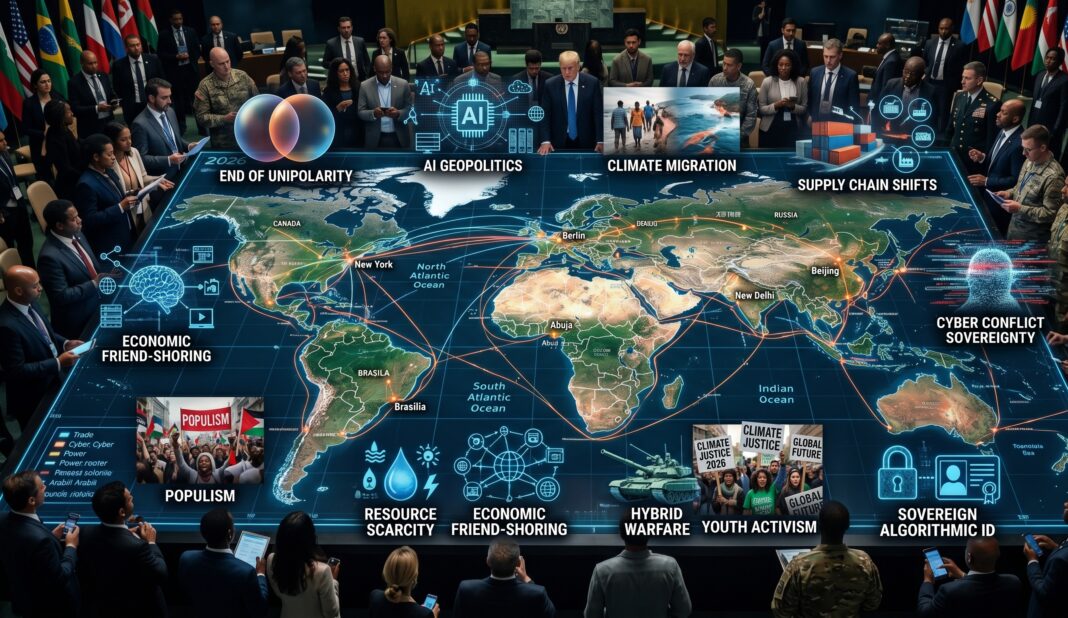
- The primary driver of global politics in 2026 is the definitive end of unipolarity, replaced by a complex, multi-hub power structure.
- Technology has transitioned from a tool to a primary theatre of conflict, with AI and cyber capabilities defining national power.
- Climate change is no longer just an environmental issue; it is a central geopolitical stressor driving migration and economic realignment.
- Economic “friend-shoring” and ideological populism are fragmenting long-standing global supply chains and alliances.
The Rise of Multipolar Power Structures
One of the most significant shifts in global politics in 2026 is the move away from a unipolar or bipolar world toward a more multipolar system. Power is increasingly distributed among several influential nations rather than dominated by one or two superpowers. Countries across Asia, Africa, and Latin America are gaining economic and political influence, contributing to a more balanced global landscape.
Why This Matters:
This shift has led to more complex diplomatic relationships. Nations are forming strategic partnerships based on economic interests, security concerns, and regional stability rather than strict ideological alignment. As a result, alliances are becoming more flexible, and international cooperation within global politics in 2026 is often issue-based rather than long-term.
Technology as a Political Force
Technology continues to reshape global politics in profound ways. Governments are leveraging artificial intelligence, data analytics, and digital infrastructure to enhance governance, security, and communication. At the same time, technology is becoming a battleground for geopolitical competition, a trend that is accelerating.
Cybersecurity has become a top priority for nations around the world. Cyberattacks, misinformation campaigns, and digital espionage are now common tools in political conflicts. Governments are investing heavily in protecting their digital assets and ensuring the integrity of their information systems, as this is a core component of national defense within global politics in 2026.
Economic Competition and Trade Realignment
Economic interests continue to drive political decisions on a global scale. Trade relationships are evolving as countries seek to reduce dependence on specific regions and strengthen domestic industries. Supply chain resilience has become a key priority, influencing the flow of materials crucial for 2026 industries.
Regional trade agreements and economic blocs are gaining importance. At the same time, economic competition between major powers is intensifying, particularly in sectors such as technology, energy, and manufacturing. The intersection of economics and security is the defining friction point in global politics in 2026.
WHAT MOST ARTICLES GET WRONG
Most analysts focus only on military hardware or GDP numbers. What they get wrong is ignoring “Cognitive Sovereignty.” In 2026, the biggest political threat isn’t invasion; it is manipulation.
When foreign actors or algorithmically driven platforms can influence a population’s reality faster than a government can react, traditional definitions of security fail. Within global politics in 2026, the true measure of power is not who has the most tanks, but who can control the narrative that governs public sentiment. True stability in 2026 comes from Digital Resilience—the ability of a society to withstand information warfare.
Climate Change and Environmental Politics
Climate change is no longer just an environmental issue; it is a central component of global politics. International agreements and cooperation are essential in tackling issues such as resource scarcity.
Environmental policies are influencing diplomatic relations, trade agreements, and domestic politics. The intersection of climate change and politics is also evident in migration patterns. Environmental factors are contributing to population displacement, leading to new challenges for governments in managing borders within the framework of global politics in 2026.
Shifting Political Ideologies and Public Expectations
Populism, nationalism, and progressive movements are all playing a role in shaping political landscapes. Younger generations are becoming more politically active. Issues such as climate change, social justice, and economic inequality are driving engagement, making domestic stability a critical variable in global politics in 2026.
Geopolitical Tensions and Security Concerns
Hybrid warfare, which combines traditional military tactics with cyber operations and information campaigns, is becoming more common. At the same time, regional powers are acting as intermediaries in conflicts, promote regional integration, and drive economic development. Their growing influence is contributing to the multipolar nature of global politics in 2026.
Source: https://www.un.org/en/un75/shifting-power-multipolar-world
Why This Matters
The evolution of these shifts is not abstract; it is already affecting your daily life. For the individual, it means that the stability you relied upon is being tested. For organizations, it means that “neutrality” is increasingly difficult to maintain. In 2026, understanding these trends isn’t just about sounding smart at a dinner party; it’s about preparing your assets, your supply chains, and your family for a world where volatility is the only constant. Without a strategy for this new era of global politics in 2026, you are highly vulnerable.
Expert Prediction: The Rise of “Sovereign Algorithmic Identity”
I predict that by 2028, the most defining trend will be the creation of “Sovereign Algorithmic Identity.” After years of information warfare, nations will move to create secure, cryptographically verified digital identities for their citizens. This will be the only way to participate in online civic life, effectively ending the era of pseudonymous digital discourse and fundamentally altering the landscape of global politics in 2026.
FAQ
What are the key trends defining global politics in 2026?
The top trends include the full emergence of a multipolar power structure, the weaponization of artificial intelligence in warfare and governance, and climate change as a driver of migration and economic policy.
How does technology influence global politics today?
Technology is now a primary theater of conflict. Cyber espionage, misinformation campaigns, and competition over critical tech (like chips and AI) are central to national security and influence in global politics in 2026.
Why is climate change a political issue in 2026?
It drives resource scarcity, which in turn drives conflict and migration. Policies designed to mitigate climate change also create new trade frictions and diplomatic alliances, making it a cornerstone of global politics in 2026.
What is multipolarity in the context of 2026?
Multipolarity means that power is no longer concentrated in one or two nations (like the US and USSR in the cold war, or the US alone after). Instead, multiple hubs (US, China, EU, India, Brazil) exert significant influence, making the system more complex.
In conclusion, global politics in 2026 is defined by complexity, interdependence, and constant change. As nations navigate these challenges, cooperation and adaptability will be key to maintaining stability. Understanding these key trends shaping global politics in 2026 provides valuable insight into the direction of the world and the opportunities that lie ahead.